Spatial incompleteness
On the unexamined work of pattern completion


The mind we experience day to day is not self-contained, but anchored in transpersonal structures that precede us and outlast us. Behind the personal moves the transpersonal. Although we do not ordinarily experience the larger structures that anchor mind, they can be brought into awareness through intentional cognitive steps.
One of the first of these steps is recognising spatial and temporal incompleteness. In this article, I want to explain spatial incompleteness.
Spatial incompleteness describes the way we recognise and complete patterns. Wherever you are, whatever is currently presented to your senses—what you see, hear, touch, feel, think, and exchange with others—constitutes your local situation. It is the immediate here-and-now of experience.
And yet, when we recognise a pattern within this local situation, we do something remarkable. We compare what is present with an idealised template that is not fully present. I might recognise the familiar form of a cloud, a cat, or a house. I may never have encountered this cloud, this cat, or this house before, but I recognise them because I am drawing on a template held nonlocally.
These templates are not simply stored privately in my head. They are held collectively—distributed across many minds, places, and histories—and they can be applied again and again, across different contexts and times. We use them not only to recognise what is already there, but to guide the completion of what is missing.
Seeing More Than Is There
When you remember a route through a town, the streets do not appear anew each time. Instead, a kind of blueprint is projected onto what you see.
The same is true when you look at a map of London. The paper itself is static, but it contains countless journeys, intentions, and futures within it—depending on who is reading it, and why.
Reading What Is Only Partly Given
We can read poor handwriting, or sentences peppered with spelling mistakes, because enough meaning is present for the rest to be supplied.
Even more fundamentally, we recognise pencil marks as handwriting in the first place—not as random scribbles, but as intentional traces pointing beyond themselves.
Acting Inside Templates
Gardening techniques, like recipes, are collective forms of knowledge. They are carried, repeated, adapted, and enacted again and again in different homes and bodies.
Recently, while digging out roses and replanting box hedges in our garden, I became acutely aware of how partial my actions were—how much they leaned on techniques I only half-understood, and how differently the same task would be performed by more skilled hands. My local actions borrowed from a much larger, shared template.
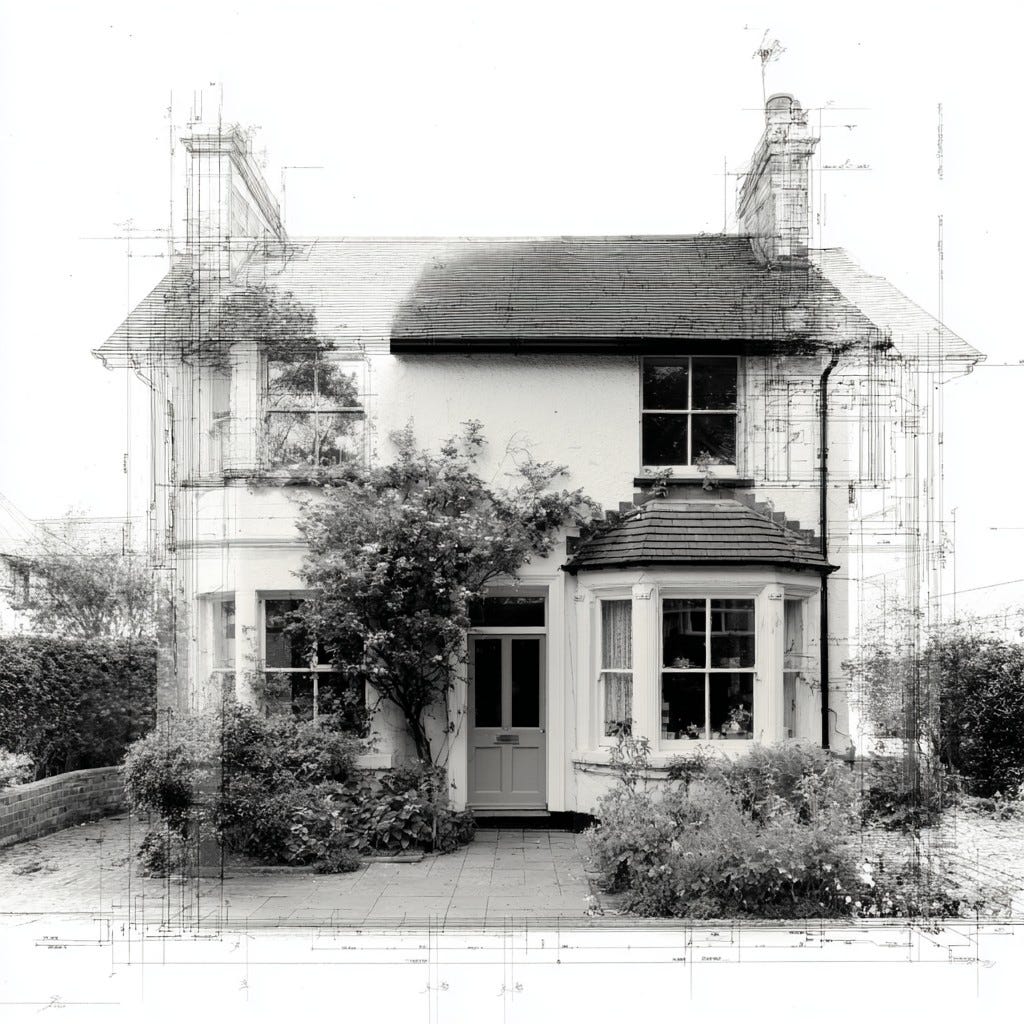
Built Forms and Living Lives
A house bears the form it bears because of an architectural blueprint.
An entire housing estate may share a single spatial template, while each house contains a completely different family life unfolding within the same underlying grammar.
Recognising the Whole From the Part
A handle suggests a mug; a wheel suggests a bike.
Half of a symmetrical pattern is enough—the other half is supplied almost effortlessly. A fragment rarely remains a fragment for long.
Mathematical Anticipation
When we see the sequence 2, 4, 6, 8…, the 10 is already present before it appears.
The pattern is not only recognised—it is anticipated. In the same way, we recognise 99 as “almost 100” and feel the completion approaching.
Try This for Yourself
Consider how your mind completes the following patterns.
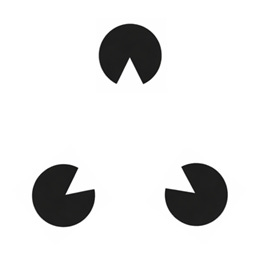
Where exactly is the arrow? What, precisely, are you seeing? If the arrow is not drawn, where is it coming from?
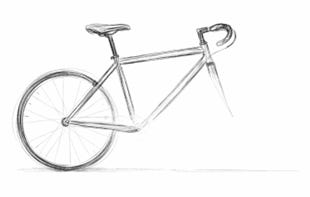
Here, the impulse is typically to mentally add a front wheel to the bicycle. Or perhaps you imagined the motion of a bicycle missing its front wheel—tipping forward until the frame meets the ground. Either way, you are drawing on an existing template of a bicycle, and perhaps the overarching directional influence of gravity, to complete what is missing.
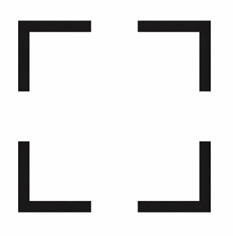
Although the square is incomplete, it is still recognised as a square. The gaps feel closable, as if an imaginary stroke of the pen could finish the job. You might even project a more elaborate template onto it—as I did, imagining a square room viewed from above, with doorways that could be walked through.
Spatial incompleteness is being presented to us constantly. With practice, we can become more lucid in noticing it—and in observing the work our minds do as they complete patterns using nonlocal templates.
Below are some suggested exercises, arranged in levels.
Level 1 – Seeing & Perceiving Patterns (Immediate, Sensory)
Cloud watching: When was the last time you took a moment to observe the clouds shifting in shape and form?
Photo edges: Take a look at a photo album, and consider what might be seen just beyond the edges of the photograph e.g. immediately to the left or the right. Who do you imagine is taking the picture? What do they look like? What are they wearing?
Purpose: Get your mind used to noticing incompleteness and the way your mind naturally completes patterns.
Note: How long did I spend on this activity before my attention moved on to something else?
Level 2 – Everyday Action & Domestic Patterns
Attend to an unmade bed
Or a pile of washing up
Seeing someone carrying too many bags of shopping and offering to help
Seeing someone hesitating at a crossing and offering to help.
Purpose: Notice patterns that invite action. Reflect on your impulse to complete the pattern.
Note: How many such states of incompleteness did I attend to in a day?
Level 3 – Patterns completed over longer periods of time
Home renovation or decoration
Building a personal routine or habit: Identify a small habit (e.g., watering a plant, journalling, walking) and observe how each instance contributes to a repeating image developed over days or weeks.
Maintaining friendships or relationships
Purpose: Observe habits that are reinforced over time, like an ideal image that becomes sharper with each repetition, consider your role in sustaining or completing them.
Note: How many days have I reinforced this same image? Is this frequent enough to strengthen and sharpen the image or is it fading and becoming less defined through a lack of investment?
Level 4 – Imagination & Creative Projection
Walking around your environment and imagine the ways in which it could be different, if you had the power to change things. What images would be realised, and where did these images come from?
Conversational gaps: In dialogue, notice how pauses or unfinished sentences draw you into completing meaning.
Purpose: Extend pattern completion into imagination, anticipation, and creativity.
Note: How long did I spend on this activity before my attention moved on to something else?
You may already have noticed that pattern completion unfolds over time—through stages, repetitions, and anticipations. Spatial incompleteness is often, if not usually, inextricably linked to temporal incompleteness.
In a forthcoming article, I will explore this temporal dimension more fully.
Appreciated this article on patterns and spatial completeness. I resonate with the importance of attending to this through small, everyday actions. You might be interested in this article by Luca Tateo: The Self as tension of wholeness and emptiness. One of your Gestalt diagrams appears there. S