
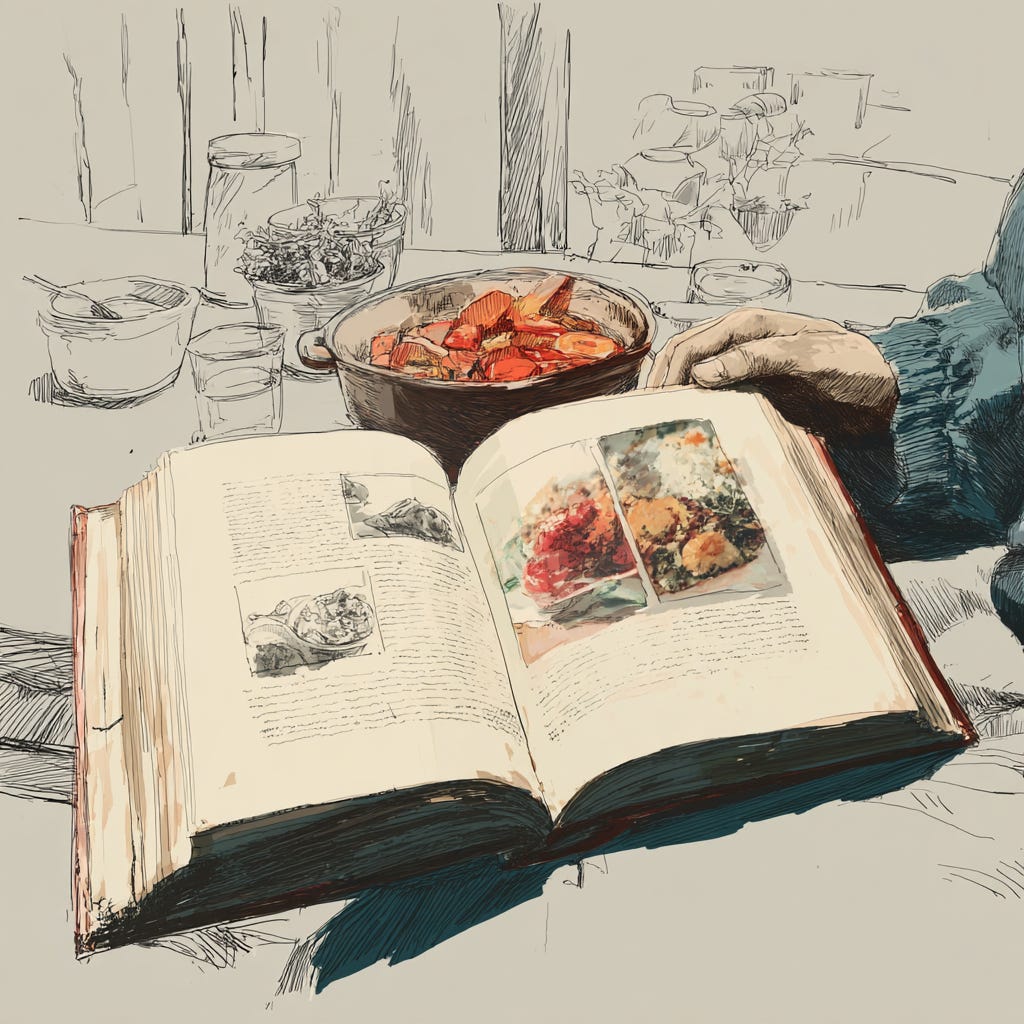
Everyday life is guided by invisible blueprints.
When you follow a recipe, obey traffic lights, write an essay, or comfort a friend, you are drawing on non-local information — patterns that have been refined and shared over time. You don’t invent a greeting every morning or rework the rules of grammar each time you speak. You lean on templates: ready-made maps for making sense of the local situation you find yourself in.
These templates — whether cultural, procedural, or bodily — are what allow us to recognise, predict, and act. They connect the non-local (stored, general, remembered) to the local (present, specific, unfolding).
Consciousness itself emerges in that connection, where the two converge. The difference between them — the gap — is what I call Gapness.
Gapness is incompleteness, the felt tension between what is and what could be. But this incompleteness comes in two main directions: one flows top-down from the non-local into the local, and the other bottom-up from the local back into the non-local.
The top-down flow: Spatiotemporal incompleteness
Spatiotemporal incompleteness arises whenever a non-local template guides our perception and action in the here-and-now. It’s top-down because we start with an ideal pattern and try to bring local reality into line with it.
You see a triangle missing one side and instinctively imagine the closing line. You watch a footballer pause before taking a penalty and anticipate the shot. You notice an unmade bed or a half-cooked meal and feel the pull to complete it. These are acts of completion: the mind applying stored templates to the present moment. The template gives shape to the scene and momentum to the act. It tells the cook which step comes next, the musician what note follows, the builder what beam to add.
In every case, there is only consciousness where there is incompleteness. When the recipe is completed and the meal prepared, we cast it out of conscious awareness. Once the morning ritual is complete, the structure built, the song concluded — awareness moves on to the next gap.
Imagine travelling to an unfamiliar part of town for a job interview. On the way, your consciousness is alive with incompleteness: Which bus should I take? Where do I change? Is this the right street? Each uncertainty summons attention, comparison, and adjustment — microbursts of gap-closing awareness. But the instant you arrive and take your seat, the geography that absorbed your consciousness vanishes from view. Those once-pressing details dissolve into the background because their gaps are closed.
As British neurophysiologist Charles Scott Sherrington once observed, “Life’s aim is an act, not a thought.” Consciousness is that impulse to action — an alignment of the local with the non-local, closing one gap before another opens. We might lose ourselves in rumination, or spend years in philosophy and soul-searching, but however long we dwell in thought, it must ultimately give way to action.
Plants show similar top-down behaviour. Phototropism directs stems toward light, climbing vines spiral to reach supports, and leaves and roots follow innate patterns to maximise resource capture. Seasonal preparation, like bud formation or bark thickening, anticipates environmental needs. Even seedlings orient cotyledons and roots according to internal plans, regardless of irregular light or soil. In each case, the template projects a top-down ideal, guiding local growth and closing gaps in space and time.
The bottom-up flow: Template incompleteness
Sometimes, however, the template itself needs updating. The local doesn’t fit, and the mismatch forces a revision of the pattern. This is template incompleteness — a bottom-up process where local experience reshapes the non-local model.
A gardener following a book’s guidance may overwater or over-prune a bonsai and watch it die. Local experience reveals that the template was too rigid. Through trial and error, a new understanding forms — more nuanced, more responsive to real conditions. A teacher notices a lesson plan isn’t working for a particular group of students and quietly improvises; next year, the plan is different. A software designer observes how users behave and updates the interface accordingly. A scientist finds an experiment produces an unexpected result and refines the theory. A therapist senses that a client’s reaction doesn’t match predictions and adjusts the approach.
Plants shape templates from the bottom up as well. In nutrient-poor soil, individuals adjust root architecture, leaf thickness, or flowering time to survive; successful adaptations gradually shift genetic and epigenetic templates. Responses to novel pollinators or microclimates may alter flower form, scent, or timing. Each local adjustment nudges the overarching template, showing that gap-closing is a conversation: the world informs the template just as the template directs the world.
Memory as the bridge
Both directions of gap-closing depend on memory. Without stored templates there can be no top-down guidance; without retention of experience there can be no bottom-up learning. Memory is what makes the dialogue between local and non-local possible.
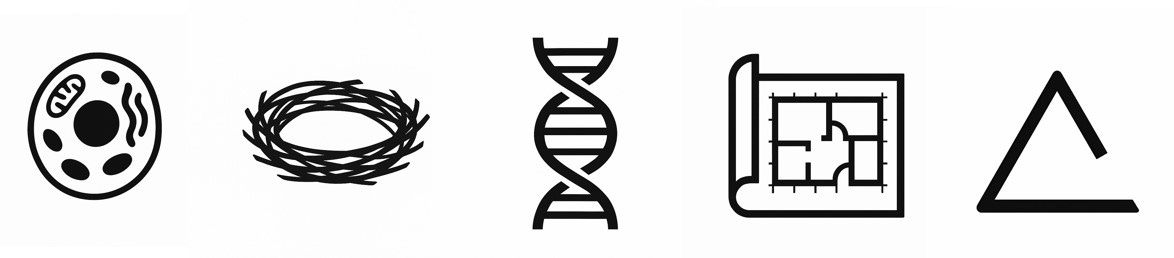
Memory comes in many forms. In the body: genetic codes, reflexes, instincts, and for plants, growth plans and seasonal rhythms encoded in DNA. In the mind: habits, language, skills. In the collective: libraries, institutions, rituals, technologies.
A child learning piano steps into a lineage of remembered practice — fingerings refined by generations. A builder uses tools whose designs embody centuries of accumulated problem-solving. A tree opening its buds in spring or directing roots toward nutrients draws on the memory inscribed in its species’ genes. Even our cells rely on molecular memories accumulated across billions of years of evolution.

We carry non-localised information on many levels, from the highly particular to the broadly general. We can hold the Sun as “our star,” while also carrying a template of stars in general, which includes the Sun as one instance among countless others. Cultural experience shapes these templates too: ask children from ten different countries to draw a house, and certain features — a roof, a door, windows — appear in nearly every sketch, yet each child adds details reflecting local traditions, imagination, or prior exposure. These shared yet distinctive templates allow us to interpret new situations quickly while leaving room for novelty, variation, and adaptation.
Nested systems of non-local information
Non-local information doesn’t exist in isolation. It’s distributed across nested systems: a recipe belongs to a cuisine, a cuisine to a culture, a culture to a civilisation. A library illustrates this: it holds information about the society, economy, and history that surrounds it. The library could not exist without a stable, prosperous environment to sustain it, yet its existence contributes in turn to the flourishing of that very society. Memory, in the form of non-local templates, is nested, relational, and fundamentally oriented toward optimising uptake and the functioning of the systems it inhabits.
At every level, the same pattern repeats: non-local templates guide local expressions, and local feedback reshapes non-local templates. A performer interprets a musical score (top-down), yet generations of performers transform the tradition (bottom-up). A city follows a planning code (top-down), yet lived use gradually revises it (bottom-up). A species expresses its DNA (top-down), yet mutations and selection rewrite the genome (bottom-up). Life learns through this oscillation — a constant breathing between pattern and instance, general and particular, non-local and local.
Behind the local moves the non-local
Behind the local moves the non-local, and behind the personal moves the transpersonal. Each of us experiences gapness — the daily pull of things unfinished — but these micro-movements occur within a vast ecology of gap-closing. The same dynamic that drives you to fix a sentence, tune a guitar, or mend a friendship also drives evolution to refine species, societies to rework laws, and artistic traditions to continually reinvent themselves.
Your small act is part of a choreography of completion — countless systems, nested within systems, leaning toward coherence. Consciousness, in this view, is not an isolated light in the skull but a local expression of the world’s continual effort to bring itself into alignment. Gapness is not an imperfection to be overcome. It is the pulse of life itself — the space where pattern meets possibility, where learning happens, where the universe senses its own unfinishedness and reaches forward.