Christmas and Structural Immortality
On loss, renewal, and generational memory

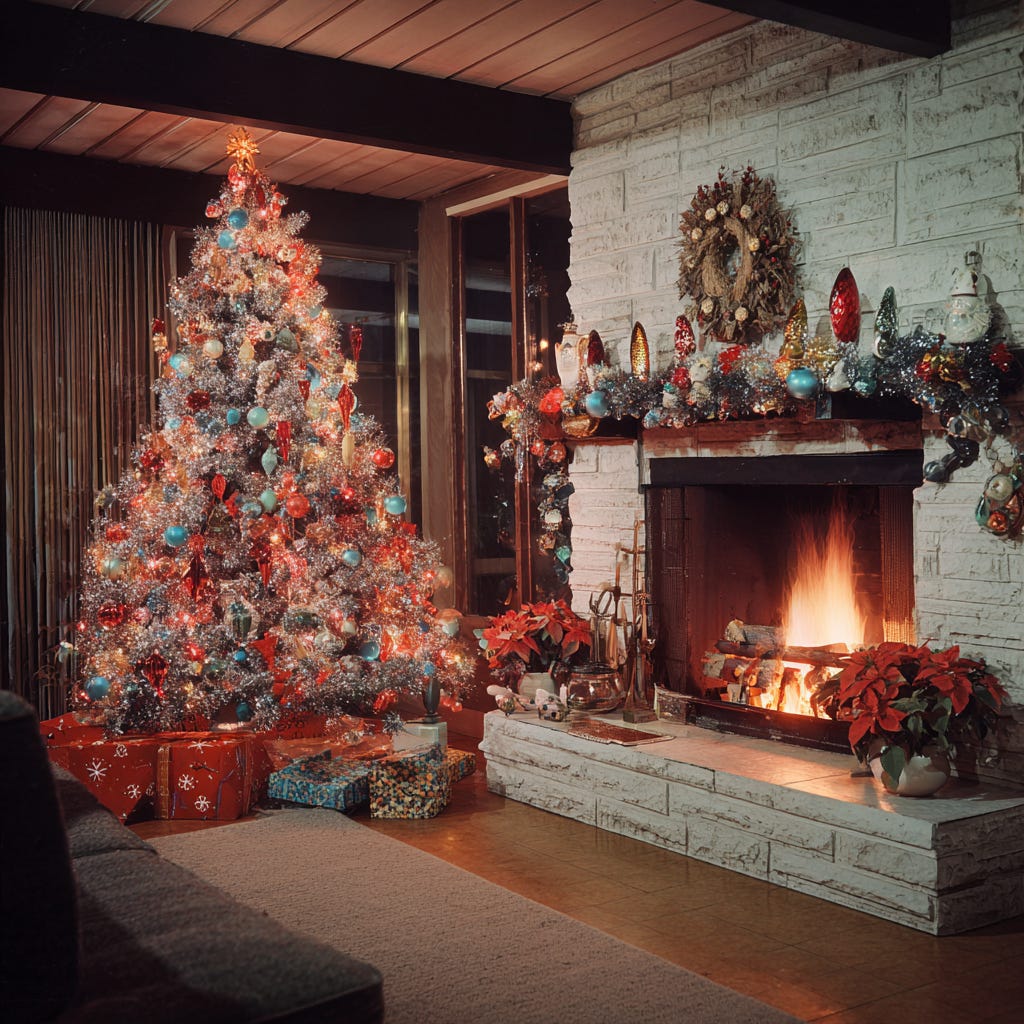
When I was a kid in the 1980s, the richest experiences of Christmas took place at my Grandma and Grandpa’s farmhouse. In my memory, they felt closer to the 1950s than to the decade I was actually living in. Bing Crosby singing White Christmas. A real fire with logs burning in the hearth. A real Christmas tree, decorated in red, green, blue, and gold — decorations I suspect my Grandma had been unpacking from the same boxes every December since long before I was born.
Every year, the template was the same. The family gathered around a long dining table. The same food appeared as reliably as the date on the calendar: turkey, stuffing, sausages, roast potatoes, carrots and parsnips, sprouts, gravy, bread sauce, cranberry sauce. Christmas pudding and a cheeseboard for dessert. Crackers, paper hats, terrible jokes.
Each year, every one of us was a year older. And yet the template itself felt ageless, repeating as though time were moving through it rather than changing it.
But we did not possess the template. It was never ours to own.
After my Grandpa died, my Grandma kept the tradition going for another decade. Eventually, she shifted to a buffet laid out in the kitchen, reducing the effort of serving everyone at the table. Family members began arriving in shifts rather than all together on Christmas Day. Then, gradually, different branches of the family made their own arrangements.
And so a continuous thread of family Christmases — one that had begun many years before I came into the world, and continued until I was about thirty — eventually came to an end.
Yet the template itself did not end.
It continues, bright and fresh, in households across England and far beyond: carols and Christmas songs written over the past hundred years; choirs and bells; advent calendars; decorating the tree; office parties; Boxing Day walks; frost and holly; red berries, wreaths, tinsel, and twinkling electric lights; candles; stockings by the fire; Christmas markets; children’s nativity plays; midnight mass; the Radio Times; the King’s speech; letters to Father Christmas; elves and reindeer; milk or port and mince pies left out by the chimney; Christmas jumpers; selection boxes; fruit and nuts; wrapping paper, ribbons, and bows — and, inevitably, credit and debt stretched by food and presents.
Some families align themselves with many of these motifs. They are participating in what we might call the archetypal Christmas, and because it works, they are likely to repeat much of it next year, and the year after. Other families take up fewer of the motifs, and their Christmas experience may vary more from year to year.
Alongside these shared structures run more idiosyncratic traditions. These may include other cultural or religious threads — the pagan celebration of the winter solstice, the Jewish festival of Hanukkah, or hybrid combinations that sit comfortably alongside Christmas. Many families in the UK celebrate Christ-mass with little reference to its explicitly Christian origins. Some attend church; for others, Christmas is largely a secular winter festival.
In truth, what we call Christmas rides on much older, non-Christian structures. There is no historical reason to believe Christ was born on 25 December. Many of the central motifs of Christmas — the decorated fir or pine tree crowned with a star or angel — owe as much to pagan and Norse traditions as to Christianity. Odin at the top of the world tree, Yggdrasil at the centre of the cosmos — the ancestors speak through structures like these.
The winter solstice matters because it marks a discontinuity. Although the cycle of seasons is continuous, the solstice is the moment when the days stop shortening and begin, almost imperceptibly, to lengthen again. A few weeks later, snowdrops and crocuses will push through frozen ground — life breaking through frost.
We live this together. We live through another winter. If winters marked us fully, they would be etched into us like tree rings — records of those times when we had to retreat, huddle, and endure.
Christianity overlaid itself onto this much older spiritual rhythm. In the early centuries, no date was set for the birth of Christ. It is thought that the Roman Empire fixed 25 December to coincide with Dies Natalis Solis Invicti — the birth of the unconquered Sun. Long before Christ, humans were already gathering, lighting fires, and marking hope on the darkest days. Stonehenge itself was built thousands of years before Christianity, aligned to the solstice.
This is the first Christmas in which my Grandma will no longer be alive.
We continue the tradition in our own home now, in this particular epoch, because we are a large enough family and because we can host it. One day, we won’t. Or it will simply make sense for one of our children to host instead. We age, and we fall away — but the tradition is handed on, ageless, renewing itself with each generation.
This is the structural immortality of Christmas: people do not live forever, but the patterns play out as though they will. Each year Christmas lives through us, as it lived through those that were here before us and will live through those that are yet to be.
Thanks so much for reading Melissa! It's nice nice to have the bandwidth to get into it and feel Christmassy 🎄
This was lovely John, very evocative and moving